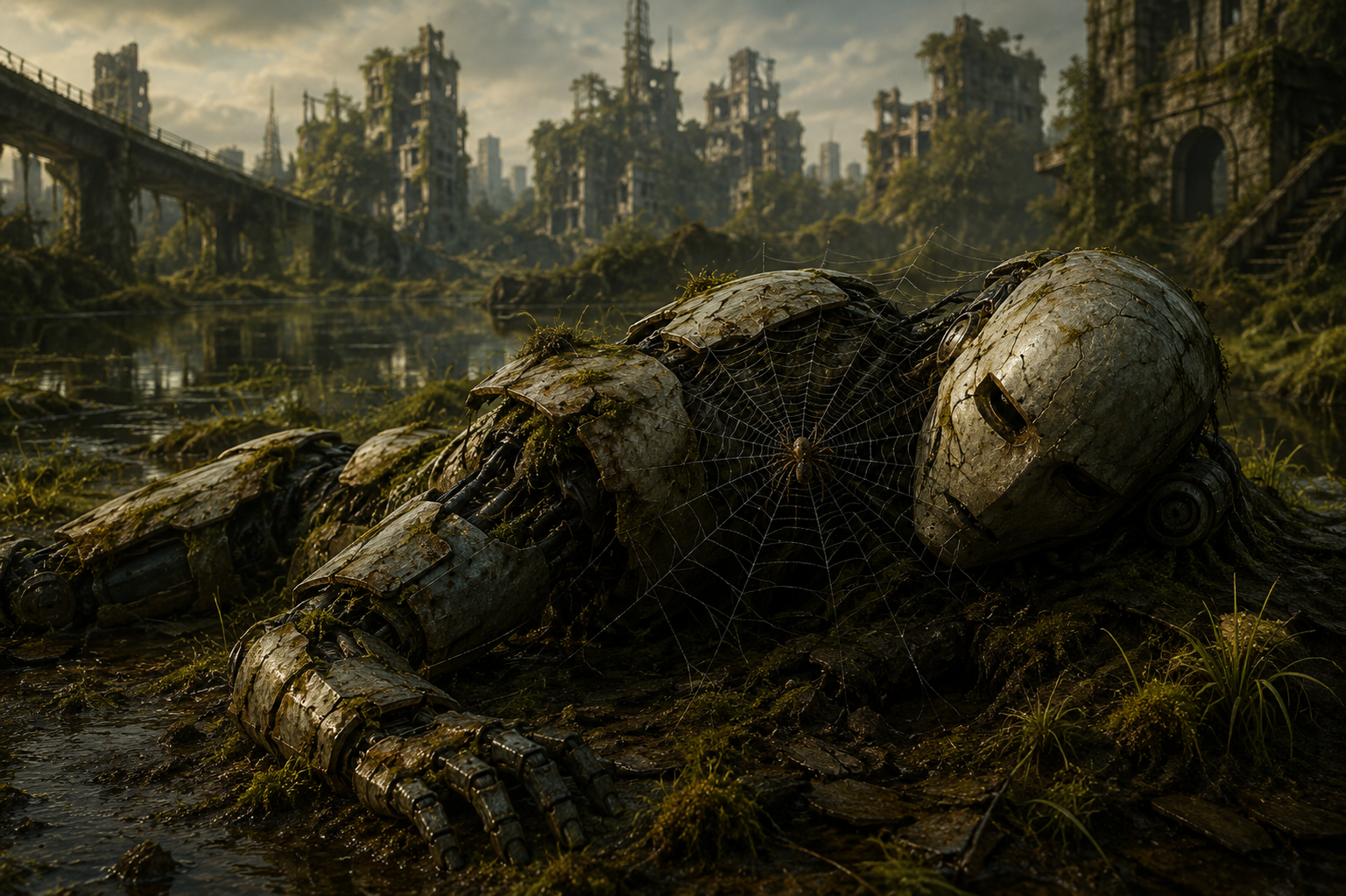
In movies and popular culture, every vision of the future looks like I, Robot.

Robots walking around doing our chores. Giant mechanical suits that make humans stronger. Autonomous vehicles, machines building other machines, enormous steel contraptions terraforming planets. Everything has motors, hydraulics, processors, wires and some gigantic battery that will inevitably be dead when you need it.
It looks futuristic, but I think it might actually be primitive.
I was listening to Dr. Zach Bush on The Joe Rogan Experience recently, and he started talking about biology and electrical signals in living things. I have no idea if Zach Bush is an authority on this subject, and this post is not based on his work. The conversation just reminded me of something I have been thinking about for years.
Humanity is spending an unbelievable amount of effort trying to make machines behave like living things when living things are already better at most of the difficult parts.
We are trying to build robots but we should be trying to program life.
The Spider Is Better Technology
Consider the spider.
A spider is born and, without anybody teaching it anything, it knows how to build a web, capture prey, eat, survive and reproduce.
Obviously, a spider does more than one thing. It is not literally a tiny robot executing three lines of code. It senses its environment, chooses where to build, avoids predators, competes with other spiders and changes its behavior based on what is happening around it… but that actually makes it more impressive.
A spider constructs its own body from locally available materials. It powers itself by eating. It manufactures silk inside its body. It builds structures. It repairs some damage. Then it creates more spiders without a factory, an assembly line or a global supply chain.
Now imagine we wanted to build a robot that did the same job.
We would need to mine and refine metals. Manufacture processors, cameras, motors, gears and batteries. Write the software. Assemble every unit in a factory. Ship them wherever they are needed. Charge them. Repair them. Replace broken parts. Install updates. Then eventually throw the whole thing away and manufacture another one…… quadrillions of times.
Natures spider just makes more spiders. It will never stop doing this. Spiders hatch, they build webs, hunt insects, mate, and the cycle repeats: for the last 300 million years, until the end of time, this will happen.
A robot is a product made by a manufacturing system.
A living organism is the product, the manufacturing system, the repair system and the power-management system combined.
That seems like a much more advanced form of technology.
Biology Does Not Need a Factory
To be clear, biology is not free.
A spider still needs energy. It needs water, oxygen, food and an environment it can survive in. It can get sick. It can be eaten. It can freeze to death. A spider does have a battery, in a sense – the battery is the insect it ate.
The difference is that the spider can and knows to find that energy in its environment, process it, use it to maintain itself and turn some of it into another spider. It doesn’t have to think about this, it will do this instinctively.
Mechanical technology pushes all of that complexity outside the machine.
The robot needs a power plant somewhere. It needs a battery factory somewhere. It needs replacement parts sitting in a warehouse somewhere. It needs a truck, boat or airplane to move those parts. It needs people and other machines maintaining the entire chain.
Biology brings an enormous amount of that machinery inside the organism.
The maintenance did not disappear. The organism internalized it.
Nature Has Already Solved the Hard Part
Nature did not sit down and intentionally design spiders to control the insect population. Evolution does not work like an engineer receiving a Jira ticket.
But evolution still produced a self-building, self-maintaining and self-replicating system that performs useful work inside a larger ecosystem.
That is the part worth studying.
The spider itself is not necessarily the answer. The answer is whatever underlying process allows a tiny egg to become a functioning spider in the first place.
Somewhere inside that system is a set of biological instructions and interactions that tells cells what to become, where to go, when to stop growing and how to work together.
We usually reduce this idea to DNA, but DNA is not a simple architectural blueprint.
A skin cell and a neuron generally contain the same genome, yet they look completely different and perform completely different jobs. Cells are responding to gene regulation, chemicals, mechanical forces, neighboring cells and electrical conditions across their membranes.
The genome matters, obviously, but it is only part of the system.
A living organism is less like a computer reading a static program and more like a distributed system in which every machine is communicating, changing roles and rebuilding the network while it is running, which is completely insane when you think about what this looks like in the context of how the internet works versus how tiny a spider is.
This Is Not Entirely Science Fiction
I am not a biologist, and I am definitely not claiming I discovered synthetic biology by staring at spiders in my backyard. There are entire fields working on different pieces of this problem already.
In 2018, researchers published a paper in Science showing that they could engineer communication between cells and cause those cells to organize themselves into multicellular structures.
That is important because the researchers did not individually grab every cell and place it in the correct position, rather, they changed the rules the cells used to communicate.
The larger structure emerged from those local interactions and that is much closer to how biology builds something versus how a normal human factory builds something.
Researchers have also created small biological constructs commonly called xenobots. They took cells from frog embryos, arranged them into new forms and produced living structures capable of movement and other basic behaviors. The initial work described a pipeline for creating reconfigurable living organisms.
Later experiments demonstrated something even stranger. Some of these constructs could move around a dish, collect loose cells into piles and create new clusters that developed into additional moving constructs. The researchers described this as kinematic self-replication.
These are not tiny intelligent animals. They are not crawling out of the lab and building cities. They are small, short-lived biological systems operating under extremely controlled conditions… but the basic result is still incredible: cells taken from an existing animal can be rearranged into a living system that does something those cells never normally do inside that animal.
We seem to be barely touching the controls, but apparently there are controls.
We Barely Understand the Smallest Systems
The other side of this is that biology is unbelievably complicated.
Researchers created a nearly minimal synthetic cell called JCVI-syn3A to study how few genes a cell needs to live and divide somewhat normally.
Even that stripped-down cell has hundreds of genes. Researchers studying it still had to work backward to determine why some of those genes were necessary for the cell to divide correctly. Their results were published in Cell in a paper on the genetic requirements for division in a genomically minimal cell.
So we can remove huge pieces of a genome, transplant synthetic genomes and edit individual genes, but even one of the simplest cells we can produce is still complicated enough to surprise us.
That is a pretty big gap between where we are and where I am talking about going. Right now, we mostly modify living systems that already exist and see what happens. We are not sitting down with a blank screen and writing a spider, but I think we should be focusing on getting to that place.
Living Materials Are Already Here
One of the most interesting areas of this research is engineered living materials.
Instead of manufacturing a material and accepting that it will immediately begin deteriorating, researchers are experimenting with materials that contain living cells or are produced by them.
Researchers have used bacteria that produce cellulose to grow materials into different shapes, detect chemical signals and help regenerate damaged sections of the material.
Another group engineered Bacillus subtilis into a living component of a silica material. The resulting material could be regenerated from a piece of the original material, and new functions could be added through additional engineered bacterial strains.
That sounds a lot more like the future to me than another robot arm. A normal material is manufactured, used and eventually discarded, you know: “wear and tear”, a living material might be grown, repaired and regrown.
We are obviously nowhere close to growing a skyscraper from a seed. These materials currently have enormous limitations involving strength, stability, environmental requirements and control, but the underlying idea is there: the material does not merely sit there, it participates in its own construction.
Electrical Signals Might Be Part of the Programming
The electrical part is also real, although it is easy to wander into nonsense when talking about “energy” and biology (one of my skepticisms of the Zac Bush episode on JRE) – it is not magic electricity or vibrations from the universe… though I will say we seem to have have a very primitive understanding of it today.
Cells maintain electrical differences across their membranes by controlling charged ions. Those electrical conditions can influence how cells move, communicate, develop and organize.
In 2025, researchers reported direct evidence that naturally occurring electric fields helped guide the collective movement of embryonic cells in a living animal. The work showed that endogenous electric fields can direct cell migration during development.
Other researchers have used electrical stimulation to influence the shape and size of organ-like tissues grown in laboratories.
DNA is therefore probably not the only lever we would need to control to truly program living form.
We may need to understand the combination of genetics, chemicals, electrical signals, physical forces and communication between cells. That is a much harder problem than editing one gene. It is also potentially much more powerful.
Give It a Job and Let It Reproduce
The version of this idea I keep coming back to is an organism designed around a function:
Not a humanoid robot. Not a conscious creature. Not something that needs to understand what it is doing. Give it one useful job and the ability to reproduce the system that performs that job.
A spider doesn’t “think” about finding food, building a web, catching insects, eating them, and mating. It is programmed to do this. It will never do anything different. All the spiders it breeds will do this.
Imagine something that detects a specific pollutant, consumes it and produces a harmless material in its place or a living material that grows into cracks in concrete and reinforces the structure or an organism that can survive in a hostile environment and slowly change that environment into something more useful… imagine deploying a small starter population instead of manufacturing and shipping ten million individual machines.
The individual organism might be less capable than a robot… but the system could be vastly more capable because, once deployed, it grows autonomously and is hands off.
Why in science fiction does terraforming have to involve enormous steel machines?
Why does useful technology have to be assembled instead of grown?
I am not saying every machine should become an animal. A living table saw sounds like terrible idea 😆.
Mechanical systems are better when we need exact behavior, high strength, extreme temperatures, sterility or an immediate off switch.
I am saying that machines are one category of technology, but we keep treating them like they are the final category.
The Problem Is the Off Switch
Of course, there are some enormous problems with all of this…..
A broken robot stops.
A broken biological system might mutate and reproduce.
The same feature that makes living technology so powerful makes it dangerous. A machine must be deliberately copied. An organism is under constant pressure to survive, adapt and create more of itself.
Researchers working on engineered microbes are already dealing with this problem. They have developed biological “kill switches” intended to destroy engineered organisms under certain conditions.
A 2022 Nature Communications paper described CRISPR-based kill switches for engineered microbes, but the paper also explains the fundamental difficulty: a kill switch creates evolutionary pressure favoring any mutant that escapes it.
That is the terrifying part.
Machines are hard to reproduce but relatively easy to recall.
Living systems may become easy to reproduce and impossible to recall.
You could give an organism a synthetic dependency so it cannot survive without a nutrient humans provide. You could limit the number of times it can reproduce. You could add redundant self-destruction systems.
But once something is alive and reproducing, evolution gets a vote. Obviously as someone born in the 80s, you know what the obvious callback here is right?

A robot is a product. A reproducing organism is life. Life, uh, finds a way.
The Future Might Not Look Futuristic
I have no idea whether humanity will ever gain enough control over biology to build the kinds of systems I am describing. We may discover that biological systems are too complex, unpredictable and dangerous to engineer this way outside narrow, controlled applications.
We may get living construction materials and pollutant-eating bacteria but never get anywhere close to custom-designed complex organisms. Maybe I am just looking at a spider from an engineering perspective and overthinking it, butI do think the basic idea is right.
The machines in I, Robot look futuristic because they move like people and talk like people. Underneath, they are still manufactured objects filled with parts that wear down and batteries that die.
A spider is grown from a microscopic package of biological information. It assembles itself, fuels itself, produces its own building material and creates more spiders.
One of those technologies seems considerably more advanced than the other.
Humanity transformed the world when we learned how to shape dead matter into tools.
The next transformation may happen when we learn how to give living matter a purpose of our own choosing.
The future may not be a machine that successfully imitates life.
The future may be life itself, rewritten.
Leave a Reply